SHOPPING APPS FOR SHOPIFY
A shopping app for your Shopify store
Your own mobile app for iOS and Android instead of an app from a builder.
muun studio from Hamburg, Germany, builds custom shopping apps for Shopify stores: mobile apps for iOS and Android, for example with Flutter, connected directly to your Shopify store, with payment in Shopify checkout. For Hagel, the app’s rating rose from 1.3 to 4.8 stars, and after the first year around 30% of revenue came through the app. In our experience a custom app pays for itself from about 3,000 active repeat customers; below that, improving your mobile store is usually the better investment.
Last updated:
HOW WE BUILD
What your app comes with
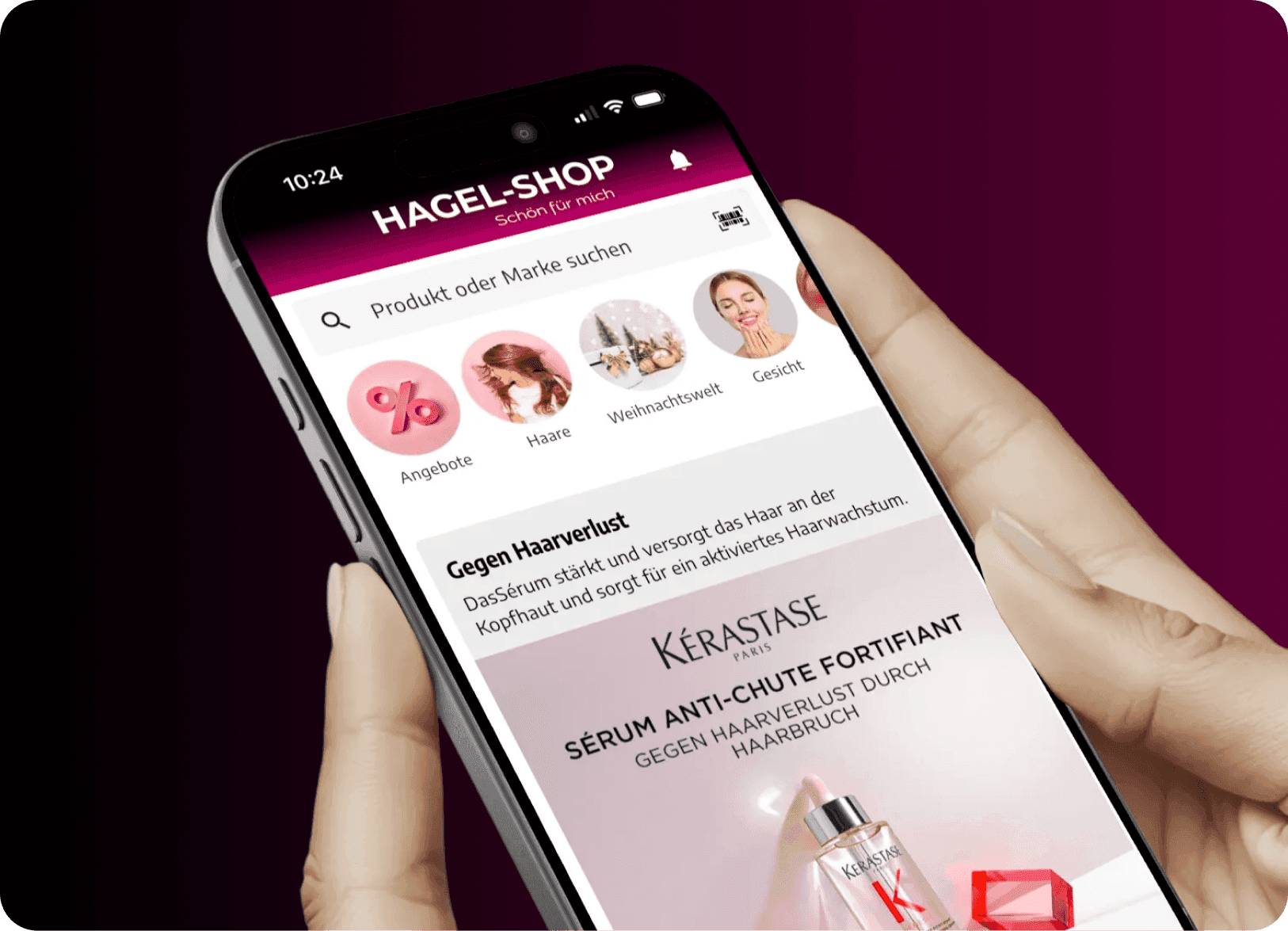
One app for iOS and Android, connected directly to Shopify. That is exactly how the Hagel app is set up.
- One app for iOS and Android
- Both platforms are built from a shared foundation. That saves development time and maintenance, and the app feels equally good everywhere.
- Connected directly to Shopify
- Products, inventory, prices, cart and customer accounts come live from your store. You keep managing everything in Shopify, and the app follows automatically.
- Payment in Shopify checkout
- Customers pay in Shopify checkout with your store’s payment methods. Orders land in Shopify as usual.
- Push, loyalty & recommendations
- Push messages, loyalty programmes and personal product recommendations, connected to your tools such as Klaviyo.
- Features the web can’t offer
- Augmented reality and virtual try-on, such as the AI hair simulator in the Hagel app.
- Analytics & operations
- We measure usage and revenue, monitor the app and ship updates safely to the stores.
DECISION GUIDE
App builder or your own app?
Builders such as Tapcart, Plobal Apps or Vajro generate an app from templates for a monthly subscription. A custom app is developed for your product range and your customers. Either can be the right choice.
| App builder (Tapcart & co.) | Your own mobile app | |
|---|---|---|
| What you get | An app assembled from templates and blocks in an editor. | A custom-built app for iOS and Android. |
| Costs | Monthly subscription. Tapcart according to the Shopify App Store: US$500 to US$2,850 per month, plus usage-based charges where applicable. | Costs for development, maintenance and ongoing development, depending on the feature set. You get an estimate after the intro call. |
| Time to launch | Fast, without your own development team. | Depends on the feature set. The Hagel app launched on the planned timeline. |
| Features | Whatever the platform offers. Custom logic only as far as its blocks and interfaces allow. | Whatever your business needs, such as special pricing, large product ranges or AR features. |
| Design | Your brand within the platform’s layouts. | Your own app design for your brand. |
| Shopify connection | Ready-made integration. | Connected directly to Shopify, checkout via Shopify. |
| Dependency | The app depends on the provider’s platform and subscription. | A custom codebase, no platform subscription. |
| A good fit if … | you want to try the app channel at low cost and standard features are enough. | you have many loyal customers who reorder regularly and the app should do more than your web store. |
| Not worth it if … | you need custom logic, such as B2B pricing or large ranges with many rules, or platform dependency bothers you. | you have fewer than about 3,000 active repeat customers, your products are mostly bought once, or your mobile web store still has a lot of untapped potential. |
Tapcart prices according to the Shopify App Store, retrieved on 18 October 2026. Other builders also charge by subscription.
WHAT’S INCLUDED
What we take care of for your app

Audit & business case
Whether it is a new app or an existing one that isn’t running smoothly: we work out whether it pays off and prioritise the features.

App design
Flows and design for your brand, tested as a clickable prototype before development starts.

Development
Your app for iOS and Android, connected to Shopify and your tools.

Launch & support
Release on the App Store and Google Play, followed by updates, monitoring and ongoing development.
CASE STUDY
Hagel: from 1.3 to 4.8 stars
Hagel is one of Germany’s largest suppliers of hair care and hairdressing products. Its old shopping app no longer did justice to the product range, and the App Store ratings showed it. We reconceived the app in workshops and rebuilt it from scratch, in this case with Flutter: around 30,000 products, many special rules for prices and assortments, plus an AI hair simulator. The store runs on Shopify, and the app is connected to it directly. It launched on the planned timeline and today has more than 4,600 ratings in the App Store (as of October 2026).
After the first year, around 30% of Hagel’s revenue came through the app. Part of that is revenue that previously went through the web store.
- stars in the App Store
- 1.3 → 4.8
- of revenue through the app after the first year
- ≈ 30%
- usage since the relaunch
- +300%
- revenue since the relaunch
- +400%
From intro call to app in the store.
Frequently asked questions about Shopping Apps for Shopify
You have really good questions, and we have found answers to them. Is your question not included? Scroll up and get in touch with Robin!
How much does a shopping app for a Shopify store cost?
It depends mainly on the feature set, custom logic for prices and assortments, and the systems that need to be connected. On top come ongoing costs for maintenance and development, because new iOS and Android versions, store guidelines and your campaigns need care. According to the Shopify App Store, a builder like Tapcart costs US$500 to US$2,850 per month (as of October 2026). It is cheaper to start with, but remains a subscription for good. In the free intro call we work out with you whether a custom app pays off for your store.
How long does it take to build the app?
The timeline depends mainly on the feature set and the systems that need to be connected. We launched the relaunch of the Hagel app, with around 30,000 products and complex store logic, on the planned timeline. Clear priorities from the joint workshops made that possible. You get a realistic timeline for your app after the intro call.
When is a custom app worth it for my Shopify store?
In our experience an app pays for itself from about 3,000 active repeat customers, and from 5,000 to 6,000 you can run it so that it keeps growing. Other good signs: your customers order at least three times a year, a large share of revenue already comes from smartphones, and you regularly run launches, promotions or a loyalty programme. There is a detailed checklist in our article Mobile App zum Online-Shop (in German).
When is a custom app not worth it?
When your products are mostly bought once and no loyal customer base forms. When you don’t yet have 3,000 active repeat customers. And when your mobile web store still has a lot of untapped potential: then it usually pays more to optimise the store first. We tell you that openly in the intro call, and when in doubt we advise against an app.
What is the difference between a custom app and Tapcart?
Tapcart and similar builders such as Plobal Apps or Vajro generate an app from templates and blocks. That is fast and needs no development team of your own, but you pay a subscription for as long as the app runs, and features and design stay within the platform’s limits. A custom app is developed for your product range and your processes, for example special pricing, large assortments or features like Hagel’s AI hair simulator. It costs more upfront but doesn’t depend on a platform subscription.
How is the app connected to our Shopify store?
Through Shopify’s official interfaces, such as the Storefront API. Products, inventory, prices, cart and customer accounts come live from Shopify, and you keep managing everything in the Shopify admin as usual. Customers pay in Shopify checkout and orders land directly in Shopify. That is how the Hagel app is connected too. We additionally connect tools such as Klaviyo or a loyalty programme.
Which technology do you use to build the app?
Whichever fits your project, for example Flutter, which builds one app for iOS and Android from a shared foundation. That saves development time and maintenance, and for your customers the app feels like any other app from the store. More on our Flutter agency for shopping apps page.
Who looks after the app after launch?
We do. After launch we take care of updates for new iOS and Android versions, monitoring and new features. We work in growth cycles: building and testing every month, reviewing results and setting priorities every quarter. We have been working with Hagel since 2025.
Let's get started together - book a free initial consultation now!
Book your appointment for a free, non-binding initial consultation.
“Do you have urgent questions, want to talk about your business goals, challenges, or our method? Let's have a chat and find out if and how we can help you. I look forward to our call!” – Eric